Phonics
The early stages of children learning to read can be daunting for many parents, with lots of phonics jargon being used by professionals in school. Our aim is to support all parents to feel confident when helping their child to practise their new reading skills at home. We hope you find the information below helpful, but if you have any questions, please speak to your child’s class teacher or Mrs Tod, who will be happy to help.
How we teach phonics at Burrowmoor Primary Academy
At Burrowmoor we follow 'Floppy's Phonics', which is closely linked to Letters and Sounds. Floppy’s Phonics is a rigorous, systematic synthetic phonics teaching programme. We use the interactive phonics lessons and activities to teach sounds, blending, grapheme – phoneme correspondences, letter formation and pronunciation to the whole class, groups or for individual practice.
The programme is started immediately as children enter Reception, with the expectation that they will be fluent readers, having secured word recognition skills, by the end of key stage one.
Phonics sessions take place every day and last for 15–20 minutes initially, rising to 30 minutes during level 1 + and thereafter 30 minutes throughout Reception and Year 1 and Year 2, if required. The children are taught as a whole class at a steady rate, progressively moving through each level. In reception, levels 1–3 are taught progressively and then, in year 1, the children move onto learning levels 4 and 5.
Progress is assessed at the end of teaching books and at the end of levels to ensure rapid progress is being made, and quick intervention can be given if required to those who need it either for sound recognition, blending or application into spelling. If there is a need to extend pupils, this is done so within that taught level, and they are not moved beyond this.
To ensure consistency and fidelity to SSP, all phonics teachers use Floppy's Phonics flashcards, friezes, sound mats and other resources to ensure consistency for children moving between groups or year groups.
To scaffold learning:
- Staff use a ‘dash' to represent each single letter grapheme and to represent a grapheme of more than one letter when spelling and writing.
- When reading, children use their 'pointy finger' to track.

- When sound talking words, each phoneme in a word is shown using the fingers on one hand raising them from right to left (left to right for the children as this is the direction we read).

- Phonics lessons are fast-paced and constantly reinforce knowledge and consolidate understanding.
- Children who are falling behind are swiftly identified and supported through targeted interventions to enable them to keep up. The same resources used in lessons are used to deliver small groups or 1:1 interventions for consistency.
- To ensure quality, consistency and continuity of teaching, training and regular coaching in the delivery of Floppy's phonics is provided by the Reading Lead.
Terminology
Grapheme – The letter or letter group which is code for the sound.
Phoneme – The smallest identifiable sound of speech.
Blending – When reading a word, identify the graphemes in the word and say the corresponding sounds in order to hear the word as a whole. E.g. read sh – o – p = shop
Segmenting – When spelling a word, break it down into the sounds you hear and write the grapheme for each identified sound. E.g. say shop = writing sh – o – p
Decode – Breaking a word down into sounds to be able to read it.
Encode – Breaking a word down into sounds to be able to spell it.
Digraph – When two letters make one sound when they are together. E.g. boat
Trigraph – When three letters make one sound when they are together. E.g. night
Split digraph – When two letters that are “split” by having another letter in the middle of them. E.g. 'a_e' in 'game' or 'i_e' in 'tide'.
Tricky words – These are common or high frequency words with unusual spelling rules which means they can’t be decoded easily. Children will learn to recognise these words by sight.
Floppy’s Phonics Online
You can access the Floppy’s Phonics sound books online through the Oxford Owl website. Login (oxfordowl.co.uk) The login for this is sent home at the beginning of the Reception Year. Once you have logged in, you will see a tab for the Floppy’s Phonics Extra Practice Zone.

Click on this tab to see all the sound books. You can filter these to the level your child is currently working on, or revisit previously taught sounds to recap learning.

Each book contains 3 or 4 sounds: a double page per sound. You can access word lists to decode together, a picture with sound buttons and other spelling and reading games by clicking on the icons on the page.

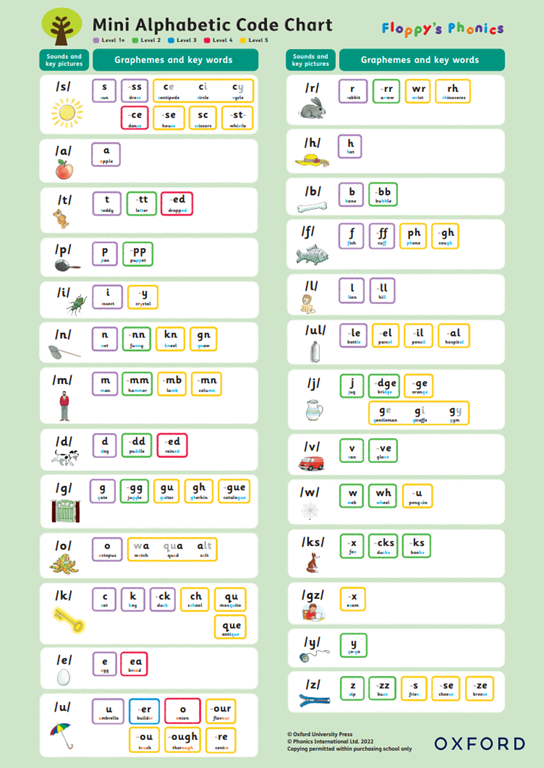
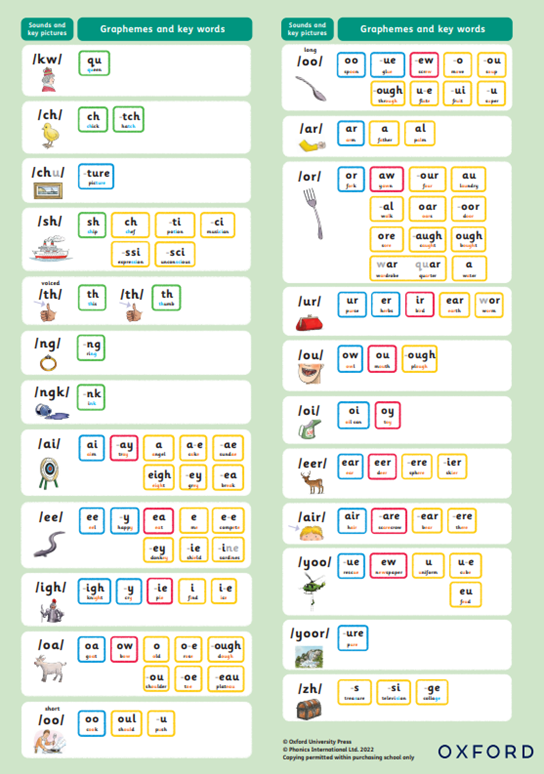
Alphabetic Code Chart
The chart shows the 44+ phonemes and their corresponding letter/sound relationships that the children are taught.
Phonics Screening Check
At the end of year 1, children sit a phonics screening to check their understanding and knowledge of phonics. To help prepare them for this, you need to practise any sounds sent home and continue daily reading. We practise these checks with the children in school so they are familiar with the content and process.